StormForge
StormForge

Storm mitigationWaterWindCoastalInfrastructure

The storm does nothave to win.

StormForge develops layered engineering systems intended to reduce the destructive forces of storm surge, flooding, waves and extreme wind before those forces become catastrophic damage.

Engineered to withstand the surge

CONCEPT1/6

Every StormForge system below is currently at the concept stage. Nothing on this site is presented as tested, piloted or field validated.How we label

§ 01Platform · 01/07

One storm. Multiple forces.One integrated defense strategy.

Hurricanes, coastal storms and severe weather can attack from several directions at once. Water can arrive as waves, storm surge, runoff or rising floodwater. Wind can create uplift, pressure changes, turbulence and debris. StormForge is developing specialized systems for these different threats and a framework for combining them into layered protection.

01

Manage destructive water

Systems intended to reduce, redirect, block or control water before it reaches vulnerable assets.

02

Reduce wind forces

Systems intended to alter airflow and reduce damaging pressure, uplift and turbulence around structures.

03

Protect coastlines

Coastal systems intended to reduce wave energy, storm-surge effects, erosion and repetitive damage.

04

Protect communities

Municipal planning that combines multiple StormForge systems around roads, utilities, buildings and vulnerable areas.

Do not just build stronger. Reduce the force.

Conventional resilience often focuses on making the asset strong enough to survive the load. StormForge adds another question: can part of that load be reduced, redirected, dissipated or controlled before it reaches the asset? That principle connects the entire StormForge family.

§ 02Defense depth · 02/07

The StormForge defense layers

Protection can begin long before the storm reaches a building. StormForge is designed as a series of potential intervention points — offshore, at the coast, at flood pathways, around properties, at structures and across municipal infrastructure.

  1. OFFSHORE

    HydraCore · StormForge Coastal

    Modular fields intended to interact with waves and surge well before that energy reaches the shoreline.

  2. SHORELINE

    StormForge Coastal

    Shoreline interfaces and erosion-management components designed to work with seawalls, dunes and berms rather than replace them.

  3. FLOOD PATHWAY

    XGate

    Controllable gateways at the roads, tunnels, channels and access points floodwater actually travels through.

  4. PERIMETER

    StormForge Structural

    Localized protection around openings, loading docks, equipment yards and low perimeter sections.

  5. STRUCTURE

    StormForge Wind

    Airflow-management components intended to change how wind moves across roofs, corners and edges.

  6. COMMUNITY

    StormForge Municipal

    Systems integration across utilities, transportation, public facilities and neighborhoods.

CONCEPT1/6

The defense-layer model above is a proposed architecture. It describes where StormForge intends to intervene, not a set of installations that have been built and measured.

§ 03Systems · 03/07

Purpose-built systems.One platform.

StormForge is a family of storm-mitigation technologies for water, wind, coastlines, buildings and municipal infrastructure. Each line below carries its own development-stage badge, and the language used for each line is limited to what that stage permits.

StormForge HydraCore emblem: a deployable surge rod rising from a stone base as a wave breaks around it, above the StormForge HydraCore wordmark.
STORMFORGE HYDRACOREBrand mark
SYS-01CONCEPT1/6

HydraCore

Turning water movement into part of the defense.

HydraCore is being developed as an active water-energy management system intended to reduce or redirect part of the destructive energy carried by waves, surge and fast-moving water.

In plain English

Imagine a large wave or surge pushing forward. Normally most of that force keeps moving toward the shoreline or structure. HydraCore explores whether part of that moving water can be captured, redirected, vented or disturbed in a controlled way, so that less organized destructive energy continues forward. In simple terms: use the water itself as part of the mechanism that fights the water.

Family role
Flagship active water / surge technology
Primary audience
Coastal engineers, municipalities, ports
Force addressed
Wave energy, storm surge, fast-moving water
Deployment concepts
Offshore modular arrays, shoreline, port
Development stage
CONCEPT — proposed architecture

What must be validated before any performance claim

  • Wave-height reduction under defined conditions
  • Pressure and force reduction
  • Effects on reflected waves
  • Scour and seabed interaction
  • Sediment transport
  • Marine-life and environmental impact
  • Structural survivability
  • Maintenance and fouling
  • Performance across varying depths and storm directions
Conceptual visualizationNot test imagery · not measured performance

The sequence below is how HydraCore is intended to work: incoming water reaches the structure, its geometry and internal flow paths interact with that pressure and movement, part of the flow is redirected vertically or laterally, and that redirection is intended to create energy loss and altered flow structure so that less damaging forward force continues toward the protected area. The rendering illustrates the proposed mechanism. It is not a record of a test, and the figures it depicts have not been measured under controlled conditions.
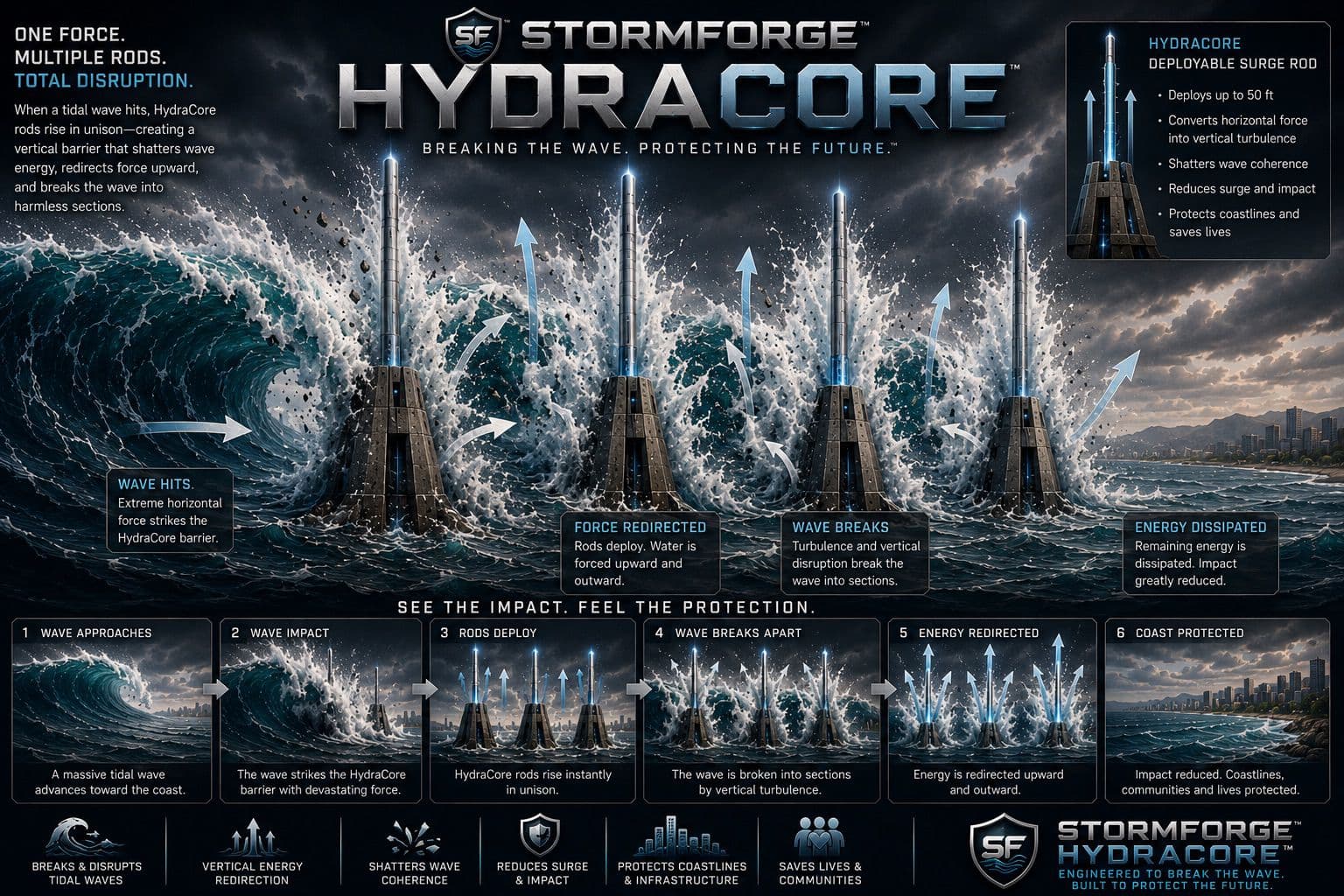
StormForge HydraCore conceptual visualization: a row of deployable surge rods rising from stone bases as a large wave strikes, with annotated callouts showing wave impact, rod deployment, wave break-up and energy dissipation across a six-step sequence.

Figure 01 — HydraCore proposed deployment sequence. Wave-height reduction, force reduction, reflected-wave behaviour, scour and survivability all remain to be determined by modeling and controlled testing.
HydraCore X-Gate emblem: crossed deployable gate arms over breaking water, above the HydraCore X-Gate wordmark reading Deploy. Disrupt. Protect.
HYDRACORE X-GATEBrand mark
SYS-02CONCEPT1/6

XGate

Control the path of floodwater.

XGate is a StormForge water-control platform being developed for vulnerable openings, corridors and flood pathways where water must be blocked, diverted or managed quickly.

In plain English

Floodwater often causes the most damage because it finds a path — a road, driveway, opening, channel, tunnel, access point or low area — and keeps moving through it. XGate is intended to create a controllable defense at those critical paths. Think of it as an engineered gate for unwanted water: normally open or unobtrusive when protection is not needed, then deployed or activated when flood risk rises.

Family role
Flood-control / deployment technology
Primary audience
Cities, facilities, flood-prone sites
Force addressed
Floodwater routing and water intrusion
Deployment concepts
Roadways, tunnels, docks, substations
Development stage
CONCEPT — proposed architecture

Design principles the platform is being developed around

  • Fast deployment or activation
  • Fail-safe behavior
  • Low manual labor requirement where feasible
  • Modular width and height
  • Integration with sensors and municipal warning systems
  • Manual local override
  • Debris tolerance
  • Serviceable seals and wear components
  • Clear inspection status before storms
StormForge Coastal emblem: a row of modular concrete wave-attenuation structures in heavy surf inside a steel ring, above the StormForge Coastal wordmark.
STORMFORGE COASTALBrand mark
SYS-03CONCEPT1/6

StormForge Coastal

Defense before the water reaches the shore.

A family of offshore and shoreline systems being developed to reduce wave energy, storm-surge impacts, erosion and repetitive damage to coastal communities and infrastructure.

In plain English

Coastal damage becomes harder and more expensive to stop once the full energy of the ocean reaches roads, buildings and utilities. StormForge Coastal moves part of the defense outward. The goal is to interact with waves, surge and flowing water earlier, so the coastline and the assets behind it face a more manageable load.

Family role
Coastal solution family
Primary audience
Coastal communities, ports, infrastructure
Force addressed
Waves, surge, erosion, repetitive damage
Deployment concepts
Offshore fields, shoreline interfaces, hybrids
Development stage
CONCEPT — proposed architecture

Coastal toolbox under development

  • HydraCore active water-energy modules
  • Passive wave-attenuation structures
  • Modular offshore protective fields
  • Shoreline reinforcement interfaces
  • Surge-routing and controlled water pathways
  • Erosion and scour-management components
  • Sensor and monitoring packages
  • Hybrids with conventional seawalls, dunes, berms or breakwaters
StormForge Wind emblem: a steel shield carrying the SF monogram with blue airflow streamlines curling over a stand-off barrier, above the StormForge Wind wordmark.
STORMFORGE WINDBrand mark
SYS-04CONCEPT1/6

StormForge Wind

Change the airflow before it becomes the load.

Wind-mitigation systems intended to disrupt, redirect or diffuse damaging airflow around buildings and critical infrastructure.

In plain English

During a severe storm, wind does more than push on a wall. It moves around corners, accelerates over roofs, creates suction, changes pressure rapidly and carries debris. StormForge Wind explores ways to alter that airflow around a protected structure so the building may experience less destructive loading.

Family role
Wind solution family
Primary audience
Building owners, engineers, emergency planners
Force addressed
Uplift, pressure differentials, turbulence, debris
Deployment concepts
Roof-edge components, stand-off barriers, envelope
Development stage
CONCEPT — proposed architecture

Validation metrics testing is intended to determine

  • Pressure coefficient change
  • Peak uplift reduction
  • Flow-speed change at critical locations
  • Turbulence intensity
  • Debris trajectory effects
  • Rain penetration
  • Structural loading under multiple wind directions
StormForge Municipal emblem: a steel shield holding a city skyline above flood barriers and roadways, with the StormForge Municipal wordmark beneath.
STORMFORGE MUNICIPALBrand mark
SYS-05CONCEPT1/6

StormForge Municipal

Build the defense around the community.

A planning and systems-integration framework for combining storm-protection technologies across roads, utilities, public facilities, neighborhoods and coastal assets.

In plain English

A city cannot protect itself with one wall or one pump. Water takes different paths. Critical facilities have different failure points. Wind and coastal exposure vary by neighborhood. StormForge Municipal starts by mapping the threats and the assets that cannot be allowed to fail, then identifies where individual StormForge systems or conventional infrastructure can create layers of protection.

Family role
System integration and planning family
Primary audience
Cities, counties, utilities, agencies
Force addressed
Combined water, wind and coastal exposure
Deployment concepts
Phased, community-scale layered protection
Development stage
CONCEPT — proposed framework

The municipal workflow

  • Map storm threats and historic failure points
  • Identify critical assets and acceptable downtime
  • Model water and wind pathways
  • Choose intervention points
  • Evaluate StormForge and conventional options
  • Design layered protection
  • Pilot high-value locations
  • Monitor performance and maintain readiness
  • Expand the system over time
SYS-06CONCEPT1/6

StormForge Structural

Protect the points where storms get in.

A building does not always fail because the entire structure is weak. A single opening, doorway, equipment area, low perimeter section or utility penetration can become the point where water or wind causes cascading damage. StormForge Structural is a set of modular storm-defense concepts focused on those local failure points — doors and large openings, loading docks, mechanical equipment, generator and electrical areas, commercial storefronts, perimeter sections, residential openings and temporary seasonal protection.

§ 04Scale · 04/07

From one building toan entire coastline

Storm surge is not simply high water. Wind and atmospheric pressure can push enormous volumes of water toward land while waves ride on top of that elevated level. StormForge is designed around multiple intervention points rather than one last line of defense — and the same modular logic scales from a single doorway to a shoreline.

01Property
Localized protection for openings, equipment, perimeter sections and facilities.
02Critical infrastructure
Hospitals, emergency facilities, utilities, substations, wastewater assets and communication systems.
03Community
Coordinated protection for neighborhoods, flood corridors, roads and municipal systems.
04Coastal
Offshore and shoreline systems intended to reduce wave and surge impacts across larger areas.
§ 05Method · 05/07

Start with the force.Find the failure path.Build the layers.

Every StormForge project is explained through the same six-step methodology, regardless of which system is ultimately selected.

Understand the threat

What water levels, waves, winds, debris, erosion or drainage failures are plausible at the site?

Find the failure path

Where does the destructive force actually enter or concentrate?

Move the intervention point outward

Can the load be reduced before it reaches the vulnerable asset?

Add layers

Do not rely on one component when multiple independent layers can reduce overall risk.

Model and test

Use simulation, prototype testing and pilot deployment to measure actual performance.

Maintain readiness

Storm systems must be inspectable, maintainable and ready before the event begins.

§ 06Claims discipline · 06/07

Engineering before claims

Storm protection is serious infrastructure. StormForge technologies are intended to move through a disciplined process of design, modeling, prototyping, controlled testing, pilot deployment and field validation. This site never converts an engineering objective into a proven result. Every technology carries a stage badge, and the badge governs the language we are permitted to use about it.

StormForge development-stage labeling system: each stage, what it means, and the language the website is permitted to use at that stage.
Stage badgeMeaningPermitted website languageStatus
CONCEPT1/6Engineering concept not yet physically validated."Designed to…" / "Proposed architecture…"Current stage
PROTOTYPE2/6A physical prototype exists."Prototype system…" / "Prototype testing…"Not yet reached — not claimed
MODELED3/6Computer, fluid or structural modeling completed."Modeling indicates…", stated with its test conditions.Not yet reached — not claimed
TESTED4/6Controlled testing completed.The measured result and the test conditions are stated.Not yet reached — not claimed
PILOT5/6Real-world pilot deployment.Location and context are stated where authorized.Not yet reached — not claimed
FIELD VALIDATED6/6Repeated operational evidence.Validated performance data may be shown with its methodology.Not yet reached — not claimed

Where StormForge stands today

HydraCore, XGate, StormForge Coastal, StormForge Wind, StormForge Municipal and StormForge Structural are all recorded at CONCEPT. Their mechanisms are proposed architectures described in terms of intended function. No StormForge technology is presented on this site as prototyped, modeled, tested, piloted or field validated, because none has yet been designated at those stages. When a stage advances, the badge, the language and the supporting evidence will change together.

What a validation record will contain

  • Technology and configuration
  • Test date and facility
  • Threat condition simulated
  • Baseline measurement
  • Configured measurement
  • Observed change
  • Known limitations
  • Link to full methodology

Engineering-development disclaimer

Certain StormForge technologies shown on this website are in development and may be represented by conceptual renderings, simulations or prototype configurations. Performance varies by design, site and hazard conditions. No technology should be specified or relied upon for life-safety or code compliance without appropriate engineering review, testing, permitting and installation for the specific application.

§ 07Contact · 07/07

Start with the threat,not the product.

Tell us what needs to be protected, where it is located and what type of storm exposure it faces. The first step is identifying the problem and the relevant defense layers.

Follow StormForge

Emergency disclaimer

StormForge is not an emergency-warning service. This website must never be used as a substitute for evacuation orders, emergency-management guidance or official weather information.

Request an engineering evaluation

Municipal · Coastal & marine · Wind & energy · Distribution

Fields marked are required